GIS Case Analysis
Full-site CRO audit for an independent expert-witness practice whose contact link had been broken on every page.
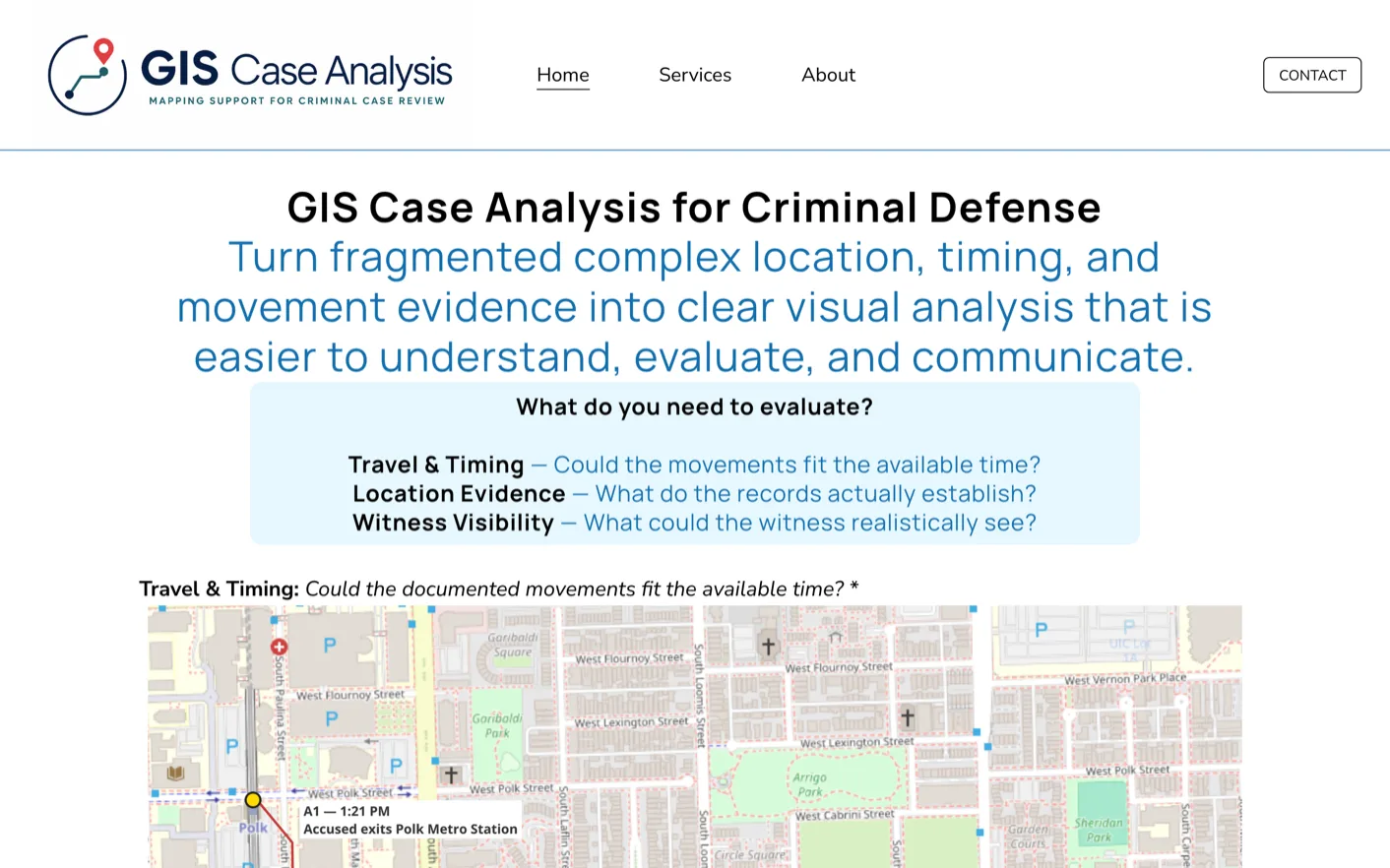
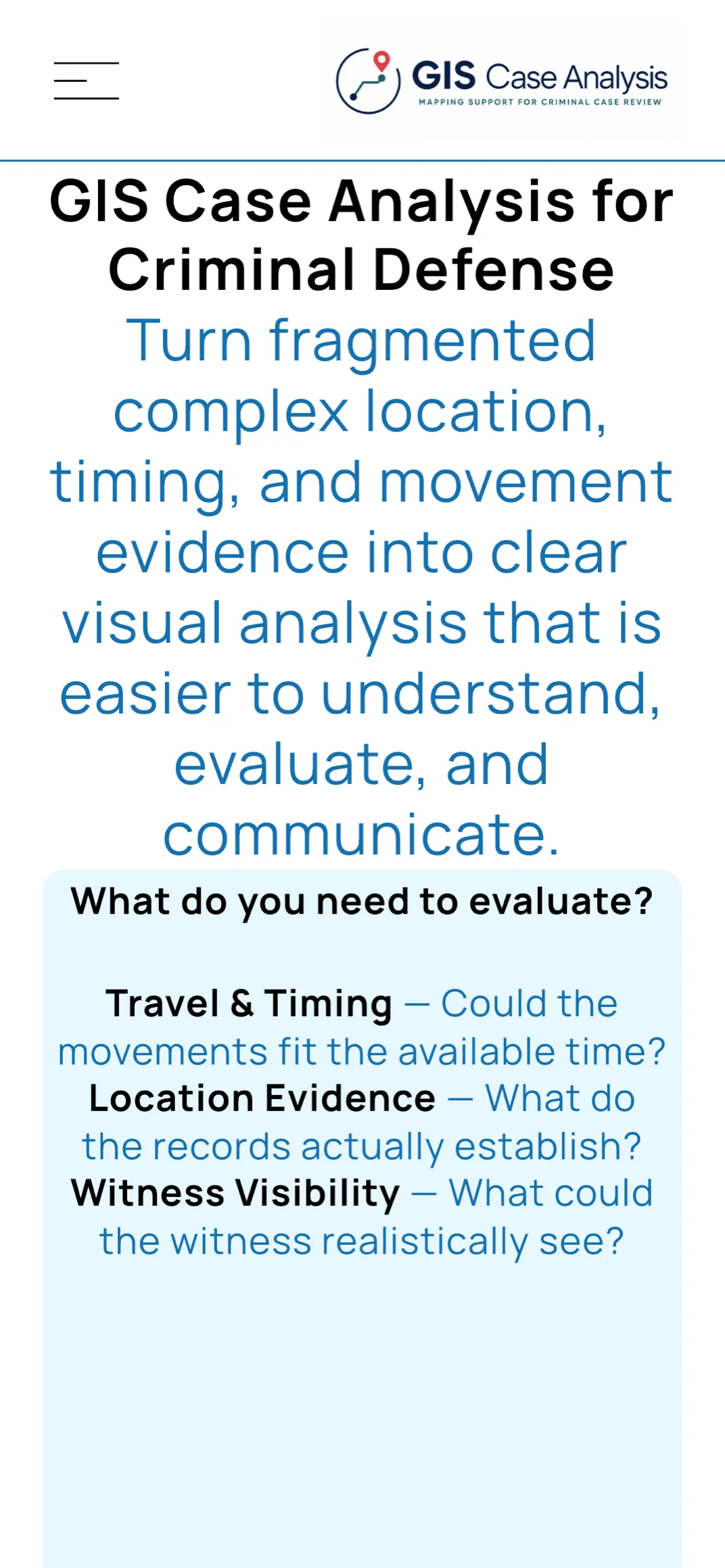
The Challenge
GIS Case Analysis is Mike Young's independent GIS consulting practice, serving criminal defense attorneys. He maps and analyzes spatial evidence: location, timing, route, and witness visibility. It is genuinely specialized work, and the analytical quality is high.
The practice was new. Traffic was almost entirely cold outbound to defense attorneys and the investigators who work for them, with no ad spend and no analytics installed. Under 200 visits, a few requests for information, no closed cases yet.
Mike came in believing he had a messaging problem. His stated goal was lowering his bounce rate, and he suspected the words on the page were the reason people were leaving.
What We Found
Messaging was the one thing already working. A visitor knew within a second that this was criminal-defense GIS work. The demonstration exhibits were excellent, the pricing was transparent in a category that hides rates, and technical SEO scored 100 out of 100. The problems were everywhere else.
No Working Way to Contact Him
The footer link on all three pages was malformed, with email, phone, and URL concatenated into a single address. It displayed correctly, so it looked fine, but clicking it opened a message to an invalid recipient. Verified in the page source: zero form elements sitewide, and no contact page at all. On mobile the only contact button collapsed into the hamburger menu.
No Proof of Qualification
No degree, certification, years of experience, testimony history, CV, or photograph anywhere on the site. For expert-witness work this is the deciding factor. An attorney is choosing someone who survives cross-examination, and nothing on the page spoke to it.
No Social Proof of Any Kind
No testimonials, references, case count, firm names, bar memberships, or directory listings. No process for collecting attorney testimonials from future engagements either, which meant the gap would persist indefinitely.
No Published Turnaround Times
For a buyer working against a trial date this is a threshold requirement, not a persuasion tactic. Its absence disqualifies silently: "can you deliver before the 14th" is often the first question, and silence loses the inquiry to whoever published a number.
Sections in the Wrong Order
No H1 anywhere, headlines fused into body copy, CTAs placed above the copy that explained them, and no closing call to action on any page. Every page dropped straight into the footer, so each one quietly stopped asking.
Mobile Experience and Page Speed
The hero filled the entire first screen, the demonstration exhibits were illegible at phone width, and largest contentful paint measured 7.3 seconds on mobile.
No Analytics Installed
No way to measure whether any change worked, and no way to see which of the three demonstration reports was pulling the most interest.
Credibility Details
Typos in two buttons, a misspelling in the social share title, a default favicon, and a shopping cart icon in the nav of a consulting site that sells nothing online. Small individually, corrosive together on a page selling rigor.
What We Recommended
The four critical fixes totalled roughly ninety minutes of work. Nothing required rebuilding the site or changing the offer.
Split the broken footer link in two
A working tel: link and a working mailto: link. Fifteen minutes, and it restored a contact path that had been silently failing on every page of the site.
Build a contact page with a case-shaped form
Name, firm, email, phone, then four qualifying fields: case type, jurisdiction, what they are trying to establish, and the deadline or trial date. That last field tells him immediately whether he can take the case. Plus a confidentiality line above the submit button to pre-empt the exact hesitation a defense attorney has.
Add a credential byline at position two
Photo, name, one line of qualification, and availability for deposition and testimony. On a site whose traffic arrives from cold outreach, the visitor's first question is whether the sender is a real person worth answering. Until that clears, nothing below it gets read.
Publish turnaround times
Even as a range. It removes the single most common disqualifier for deadline-driven work.
Reorder the page: proof before price, with an early anchor
Exhibits ahead of the rate card so the number is judged against demonstrated value. But because his pricing is unusually low for expert work and reads as a positive surprise, a single anchor line goes in the intro while the full rate card stays at position four.
Install analytics before making structural changes
GA4 and Microsoft Clarity, both free, fifteen minutes together. With traffic this new, a week of session recordings shows where attorneys actually stall, and which of the three demonstration reports gets opened most.
Start collecting testimonials from engagement one
Affiliations, directory listings, and memberships are available before the first client exists. A named attorney quote would become the strongest asset on the site, so the ask needs to be built into delivery rather than remembered later.
The clearest summary was in the journey table: the path succeeded at the two hardest steps, proving analytical skill and publishing honest pricing, and failed at the three cheapest. Credentials, turnaround times, and a contact form are an afternoon of work between them.
The Deliverable
Delivered as a professional document in one business day:
- Executive summary with eight priority issues ranked by conversion impact
- A "what is working and should not be changed" section, so nothing load-bearing gets torn out
- ICP analysis covering who actually reaches the site and what each visitor is deciding
- Seven-row persuasion scorecard grading authority, social proof, urgency, commitment, liking, scarcity, and reciprocity
- Seven-step journey table tracing the path from landing to contact, with a verdict at each step
- Competitive landscape
- Three wireframe plates: current versus recommended structure, recommended layout in detail, and the mobile first screen
- Eight priority fixes, each with impact rating and a today / this week / after sequence
- PageSpeed findings with the specific culprits
- Implementation checklist and a recommended eight-position page structure
Findings were verified against live page source and full-page screenshot captures at 1440px and 390px, with performance measured through Google PageSpeed Insights.
Client Response
"The report I received was loaded with insight and improvements. I dropped it into ChatGPT and it was able to walk me through making all the changes myself."

That second sentence is the part worth noting. The document is specific enough that a non-technical owner can hand it to an AI assistant and execute it without hiring anyone else. That is the intended outcome of a $99 audit, not an accident.
Want the same analysis
for your site?
Full CRO audit. Every element analyzed. Prioritized fixes delivered within one business day.